
Update Jan 10, 2025: the FCC granted the “license to cover” today and we turned WMVC on full-time. 🙂
Original post follows…
Our client WMVY (aka MVYRADIO) won a new construction permit during the 2021 FCC Filing Window for new, non-commercial radio stations. The trick is that they couldn’t quite get the signal they needed…but they got it good enough for now.
The first step was to apply for a new 91.5FM signal in Edgartown: WMVC. When it comes to getting a new license from the FCC, the name of the game is “singletons” – applications that can be granted immediately because there are no other applications that are “MX’ed” (mutually exclusive) to yours. While one must be cautious and thoughtful, it’s almost always better to do whatever it takes to make your application a “singleton” so it can be granted right away, and plan to modify it later if you can. That’s better than getting in an “MX Group” where it might take months or years for the FCC to render a decision on who gets the license, and it could very easily not be you.
In this case, there were other applications on the mainland that were also for 91.5FM. So their initial “MX’ed” app was quickly re-filed to move further southeast into Edgartown and to a lower height and smaller power to make it a “singleton”. Soon thereafter? Success! The FCC granted the “Construction Permit” for a new 91.5FM signal in southeast Martha’s Vineyard, licensed to Edgartown. So far, so good: getting the CP is usually the hardest part.
Side note: any regular WMVY listener hears every hour that their signal is “WMVY 88.7FM Edgartown,” meaning its Community of License is, in fact, Edgartown. Even though the actual signal covers all of the Vineyard and a goodly portion of Cape Cod. This new WMVC 91.5FM signal is also licensed to Edgartown but, as it so happens, will realistically be listenable only in Edgartown proper itself.
Winter Construction = A “Cold Reception”
The rub was that there are very, very few towers on the Vineyard, and even fewer that have space for a new FM antenna. New FCC Construction Permits expire after 36 months, so our deadline of March 2025 was fast approaching! Especially since installing an FM antenna in the winter on an offshore island is an unpleasant experience at best: cold, windy, often rainy/snowy. Blech! We needed to get this thing built and on the air ASAP.
Fortunately some friends of MVY at the Winnetu Resort in Katama (kah-TAY-mah) offered space on their rooftop to host a minimal version of this new “WMVC” signal. The only caveat was we couldn’t build until after the Winnetu closed for the winter in October. The summer was spent planning the install, coordinating with various contractors and stakeholders, and ordering equipment; organizing things on an offshore island complicates logistics considerably. At last, L&R was scheduled to actually build WMVC on November 1st and 2nd.
With a bit of “know a guy who knows a guy”, we had two indispensable helpers to help us lug a lot of steel parts and cinderblock ballast up an extension ladder onto a “widow’s walk” on top of the roof. The antenna and RF cabling was all day on the first day, and setting up the transmitter and related gear was all done by the second.
The antenna is a single Nicom BKG77 broadband FM antenna. I hadn’t used the BKG77 but it came highly recommended and I must say I am impressed. It arrived well-built, but not overbuilt. And when installed it yielded a mere 0.5 watt reflected to 270 watts forward power. The crossed-V design also does a nice job reducing upward/downward RF emissions, which is important for RF exposure compliance when you’re on a rooftop.


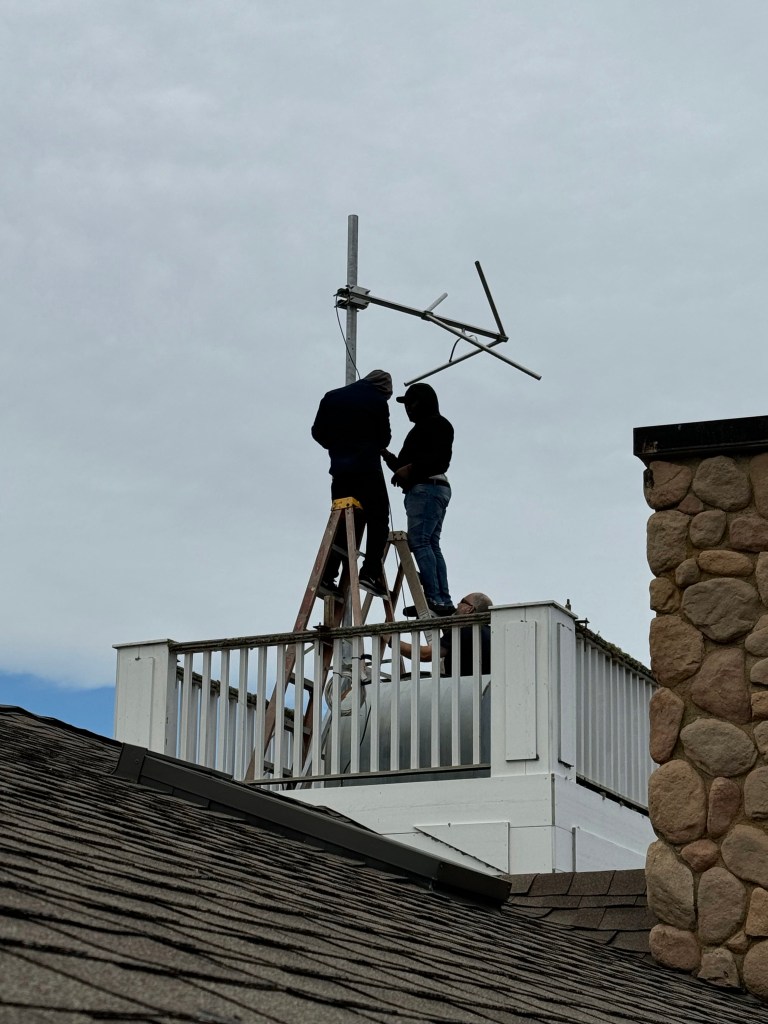
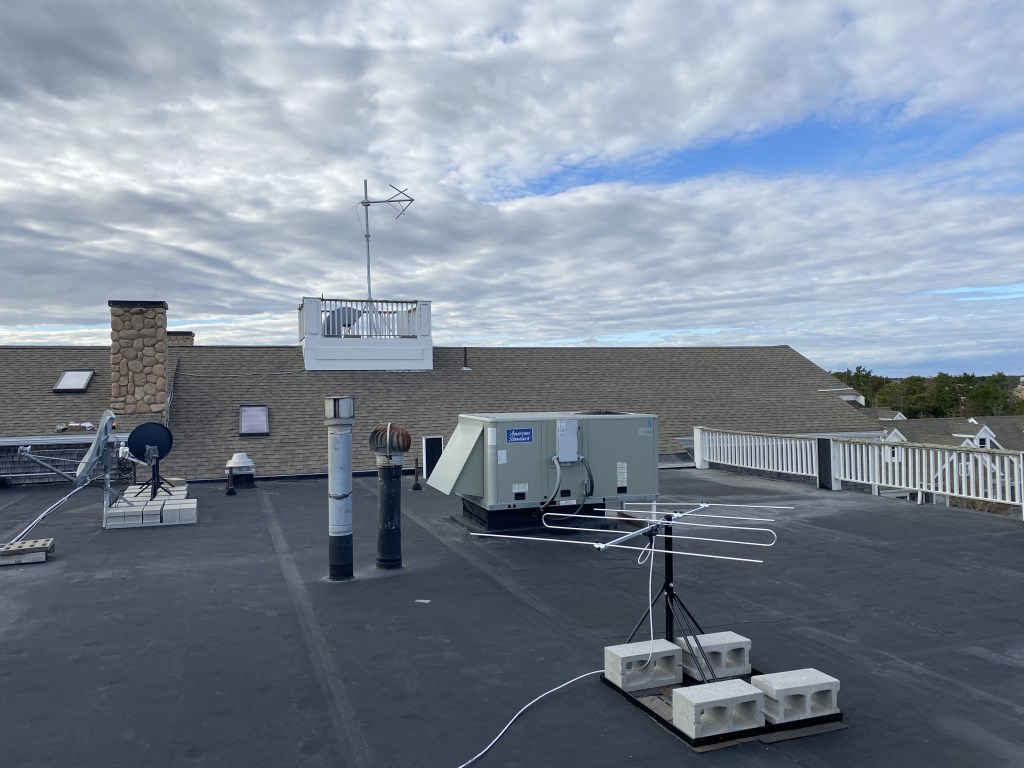
A Baird non-penetrating roof mount (NPRM) with a 15ft pole puts the Nicom juuuust high enough that RF exposure is not a problem on the floors below the antenna; it is a mere 100 watts Effective Radiated Power (ERP), after all!
LMR240 cable was employed thanks to its extra flexibility and narrow diameter; the line-loss was considerable (-1.3dB over 50ft at 88 MHz) but for this installation that didn’t matter. Worth noting: it’s rated for approximately 400 to 500 watts…but even at 270w you could feel the cable getting slightly warm. I wouldn’t use it for much more than 300 watts.
In consultation with our client, we decided on a new Nautel VX300 FM transmitter for WMVC. The VX series is pretty new, and just started shipping a year or two ago. As such, it benefits mightily from the recent revolution in radio transmission electronics: more features, smaller package, higher efficiency, and lower costs. It wasn’t all that long ago that a 300 watt transmitter might be 6 to 8 RU (“rack units”; 1 RU = 1.75 inches), have barely any remote control or telemetry, and draw enough current that a 220VAC outlet was worth considering.
These VX series are:
- Well over 50% efficient (AC to RF) meaning they need less cooling and use less electricity).
- Occupy just 2 RU, thus making it easy to fit in a tight space.
- Have a built-in web GUI (graphical user interface; think “built-in website”) that lets you control pretty much everything, and even have a basic spectrum analyzer!
- Use a very standardized power supply that’s modular and easy to swap in/out if needed.
- Cost roughly half what an equivalent unit would 20 years ago!
Our studio/transmitter link (STL) is an Inovonics AARON650 receiver tuned to 88.7, with a Stellar Labs 30-2460 four-element yagi reception antenna. The 30-2460 are cheap antennas and not terribly sturdy. But it only needs to last a year or two, and it’ll do that just fine.
The AARON650, however, is a top-notch receiver. Able to pick up the faintest FM signals as if they were locals, and it has a horde of features packed into it…all accessible via a remote web GUI. Including the ability to automatically “fail over” to a webcast feed for audio if the FM signal drops too low, or if the RDS PI Code fails, or if the audio just goes away for too long. It also has stereo composite regeneration that’ll preserve the existing PS/RT RDS from 88.7FM but change the PI Code. That means the new 91.5 station identifies itself correctly as “WMVC” instead of “WMVY”, but it still has the artist/title information WMVY also has.
Best of all, Inovonics’ tech support / customer service is excellent. They’re based in Fulton CA (near Santa Cruz) and always get back to me quickly with helpful advice and answers.
MVY’s studios are across the island in West Tisbury, and behind some hills near where the airport is. So we knew it would be nigh-impossible to receive 91.5 at their studios. An Inovonics InoMini 635 SiteStreamer was set up for monitoring WMVC, both automatically via silence sensor (and RDS sensor) and manually via a built-in webcast server.


Necessity + Eager Help = Creative Solutions!
I cannot say enough about how great the Winnetu, especially facilities manager Curt Girard, were about hosting WMVC. Not just willing to allow us to put our gear on their building, but actively eager to help us make it happen.
However, enthusiasm aside, the resort just didn’t have a “proper” tech room to put the transmitter in. We had to make use of a “cubbyhole” pretty much right below the rooftop widow’s walk. Nowhere near large enough to hold a proper rack, we instead employed rack rails that can be mounted horizontally (so the equipment is vertical). This makes it difficult to physically get at the rear panels of the gear, and it means more dirt/dust tends to accumulate on the front panels…so regular checking/cleaning of the air filters is necessary. But the tradeoff is worth it as we never would’ve fit the hardware in this tiny space otherwise!
Comcast/Xfinity Business provided the internet service for remote control & telemetry, and a Digital Loggers Inc Web Power Switch Pro provides the ability to remotely power cycle any device that might get “locked up.” It also has an “auto ping” system where if it can’t ping a certain, reliable, server for too long, it’ll cycle the power for the cablemodem on the assumption the cablemodem has locked up. This used to be a bigger problem than it typically is today, but it still happens sometimes. And it’s an expensive hassle for one of us to take a ferry over to the island and drive 20+ minutes to Winnetu just to unplug/re-plug the power on a cablemodem…so the auto-ping is a handy “security blanket”, indeed.
Last thing to do before we applied for the “License to Cover” from the FCC was to install some carefully-situated RF Caution & RF Warning signs. They’re positioned to be invisible to anyone BUT a person who’s physically climbed up onto the rooftop. Yet also positioned to be very visible for the workers who must go up there occasionally. The signs also tell those workers what to do and whom to call to have WMVC turned off if/when they need to work around the “widow’s walk” where the antenna is. Everywhere else up there is perfectly safe; it’s just the few feet around the widow’s walk where RF exposure level is just barely above the threshold.


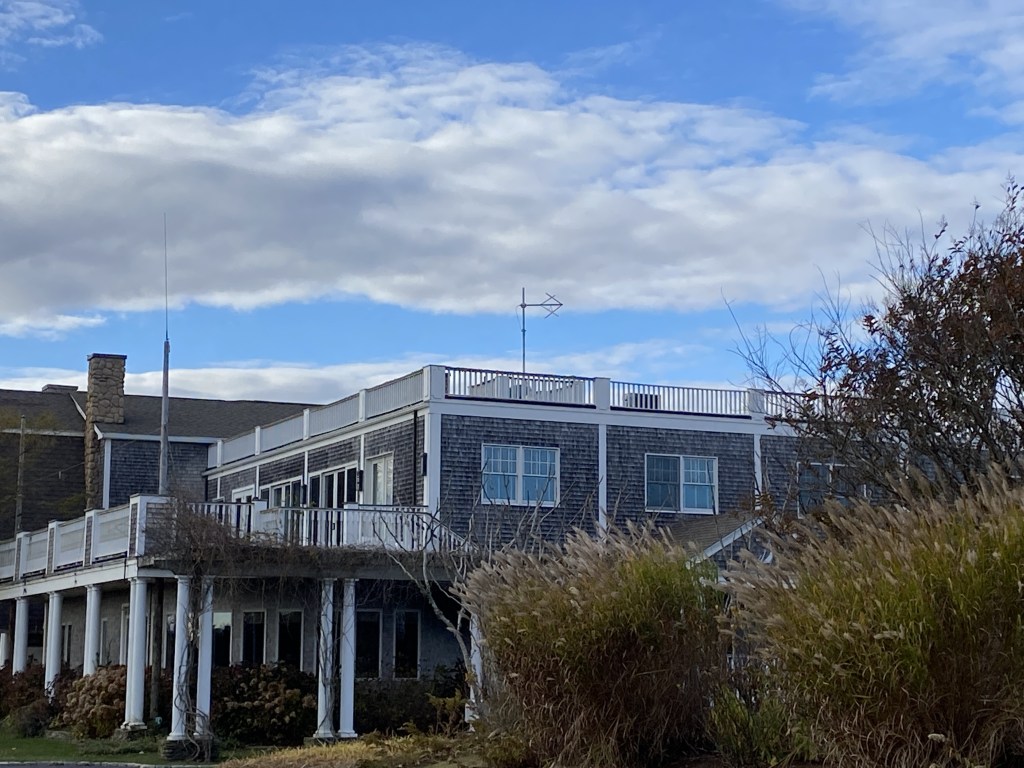

Still, this was a fun project, and very satisfying to do it when we did. The first day was 60-65F…on November 1st, mind you…and was windy as heck! Constant winds around 25-30 MPH with gusts considerably above that. We were mostly in the lee of the rooftop but putting that final pole up on the roof peak was quite tricky with those winds blowing men and material around. Your Intrepid Engineer was serving as important “ballast” himself to help keep the folded ladders firmly in place.
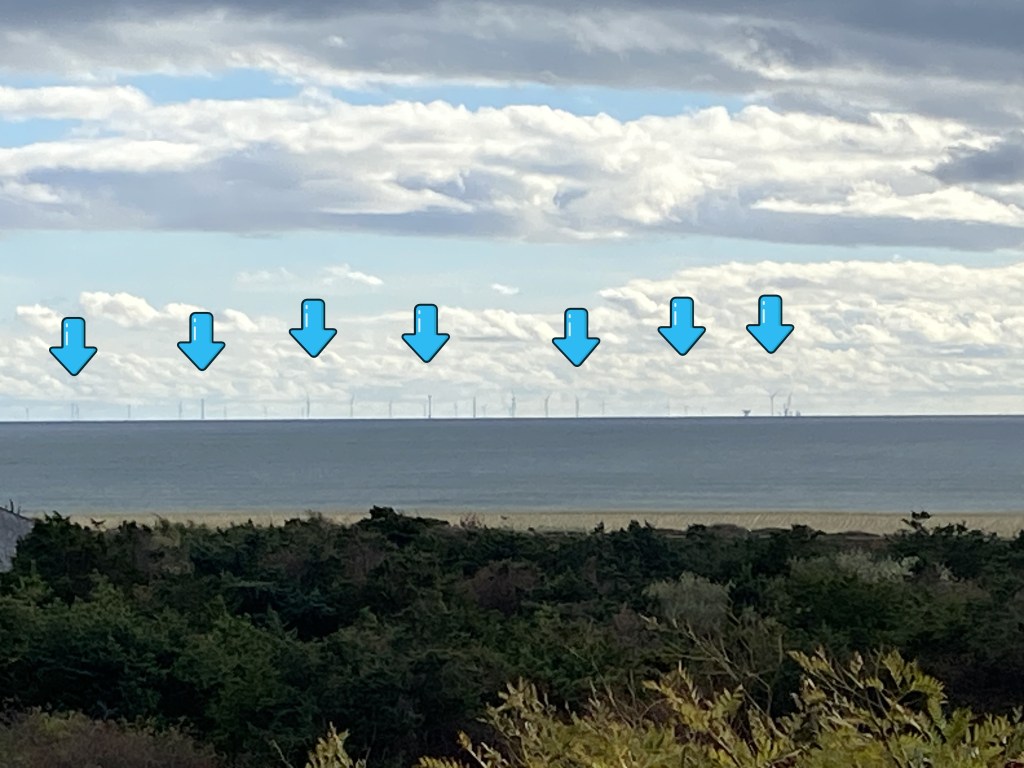
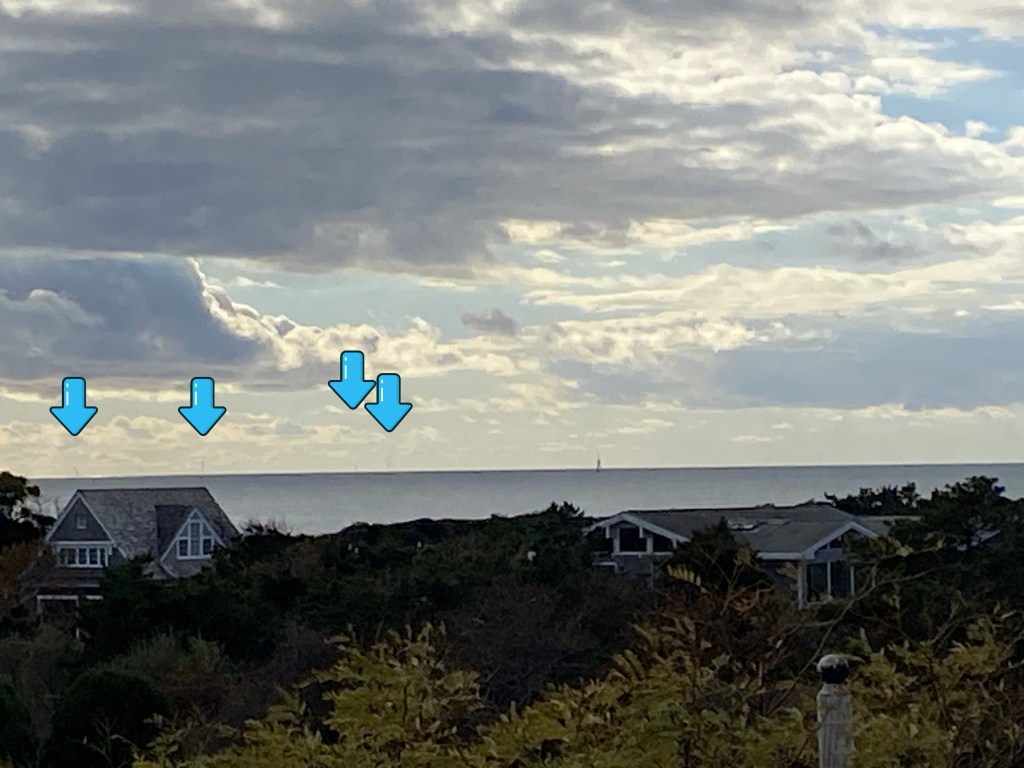
The next day, Nov 2, was considerably cooler (in the low 50’s) but still comfortable and far less windy. The clear skies revealed what wind-whipped ocean spray hid the first day: the extensive (and growing) offshore wind turbine farm off the southern coast of the Vineyard.


Initial testing on day 2 demonstrated surprisingly good coverage. You could hear 91.5 a ways past the airport in the center of the island, and about halfway to Oak Bluffs whilst listening on on the station’s “company vehicle”: a Toyota RAV4 with a stock radio.
Again many, many thanks to Maurice & Sheldon (and their supervisor, Reggie Chambers!) for their help on the roof. And to the entire Winnetu Resort, especially facilities manager Curt Girard. Also PJ Finn, Marianna Cibulasova and Rogers Brandon of MVYRADIO.


 L & R Broadcast Services
Leave a comment