
Since long before your Intrepid Engineer started working for The Public’s Radio in 2012, the WNPE 102.7FM facility had a Scala CA2/FM (PDF) antenna about 70ft up the tower. The precise details aren’t known, but it’s reasonable to assume it was tuned to 95.5 MHz for reception of then-WBRU (now WLVO) for purposes of receiving the In-SIGHT Radio Reading Service (for the blind), and rebroadcasting it on WNPE.
TPR’s deal with purchasing now-WNPN included our commitment to the Audible Local Ledger reading service, and as it happens InSight discontinued the radio reading service at the end of 2022 anyways. But we kept the receiving antenna up there because it was handy for receiving a lot of other radio stations, too. Most notably our own 89.3FM signal as an emergency source of content for rebroadcasting, and for monitoring the 89.3HD2 on one of our Nielsen MCEM’s (Multi-Channel Encoding Monitor) that’s based at WNPE’s tower.
This remained true even as the antenna got older and older, and also got more and more physically out of whack. Towards the end, the parasitic reflector element (the back one) was nearly 90 degrees perpendicular to the main element (the front one). They’re supposed to be in the same plane. Oops.

So a few years ago, I put a cheap Stellar Labs 30-2460 FM yagi antenna on the roof of the shelter as an alternative, and despite being only 15ft above the ground, it worked just fine.
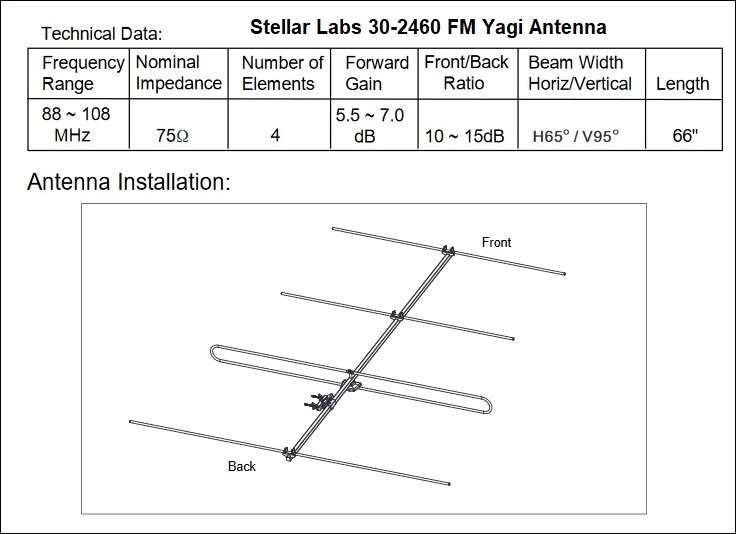
Courtesy of the TVfool forums.
Earlier in 2024, though, things went to hell. The Stellar Labs antenna looked fine from ground level, but its reception was terrible. And every time it rained, reception got very poor on the Scala CA2 higher up, as well; a sure sign water was getting into the RF cable.
At first I tried installing a SAMCO SAM159FM (PDF) five-element yagi that I borrowed from another site. It was slightly higher on the tower (about 20ft) but performance was still quite poor. I later heard that SAMCO’s build quality has become very hit or miss in recent years. (dammit!) So that SAMCO is going to be re-tasked to situations where I’ve already got plenty of signal present and antenna performance can be mediocre but still function as needed.
I wasn’t relishing buying a new Scala CA2. They’re great antennas, but they cost about $2800 each! Fortunately, an opportunity arose for me to salvage some fairly new (roughly 2006 vintage) FM antennas from the roof of UMass Dartmouth’s campus center: a Scala CA2/FM yagi tuned to 89.3FM, and a Scala CL-FM/HCM log-periodic antenna. The log-periodic I have plans for at the Westerly bureau…but the CA2/FM I had a feeling would be ideal for WNPE.
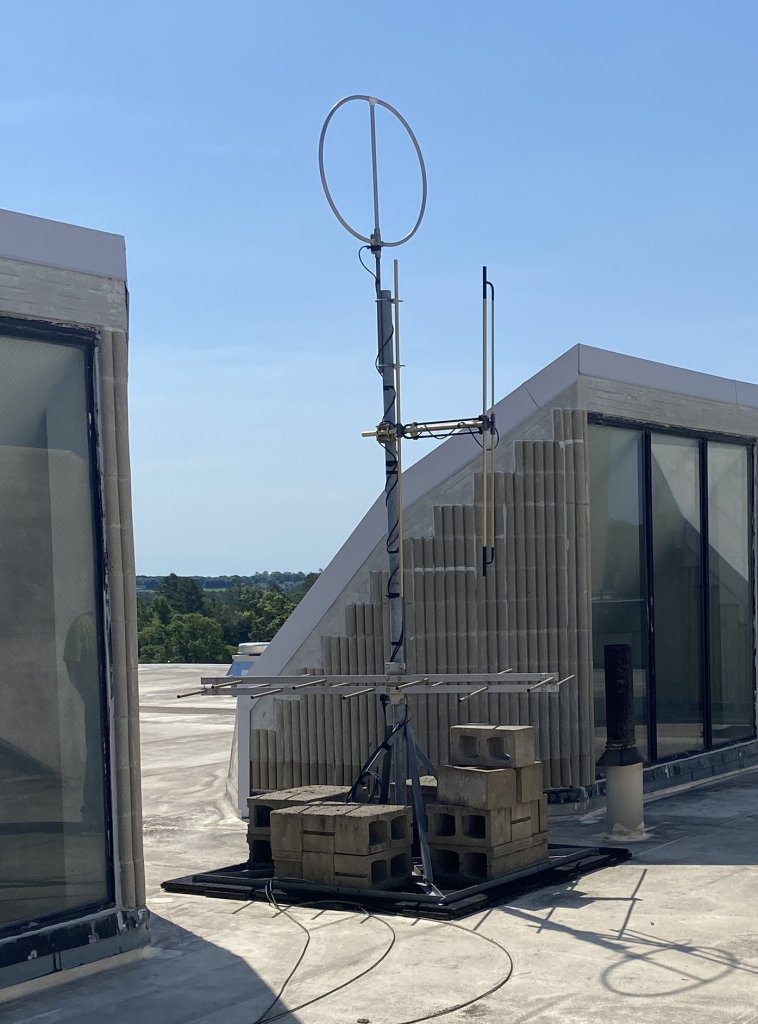
From top to bottom: Belar AM loop, Scala CA2/FM, Scala CL-FM/HCM.
Before putting in the CA2/FM, I wanted to test the Stellar Labs first. Climbing up on the roof, I saw nothing obviously wrong. First step was to try re-mounting it vertically-polarized instead of horizontally. Turns out the first step was the last step: after removing the antenna from the pole and tilting it, a whole bunch of rain water leaked out of the “box” where the antenna connects to the RF cable via the F-connector. As we say in the industry, well there’s your problem!
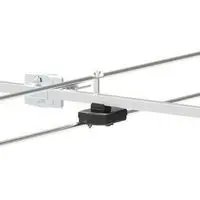
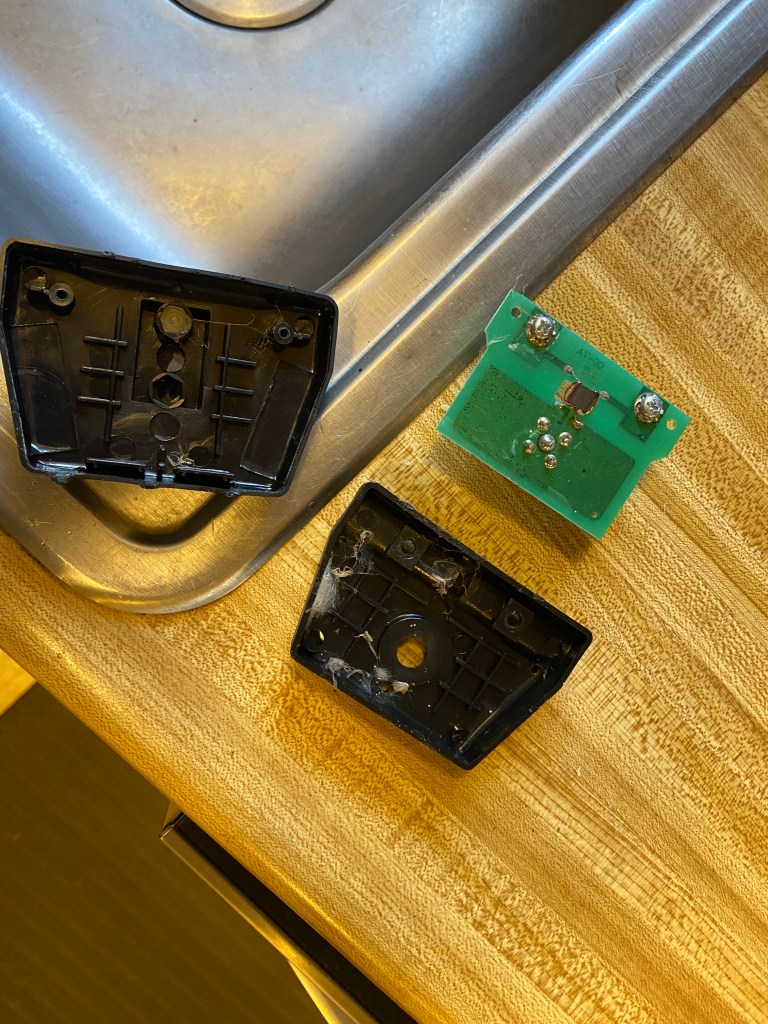


Water in the connector like that means the electrical nature of an RF signal is essentially dead-shorted. It’s sort of like sticking a fork in a power outlet, but less “sparky-sparky”. It’s still bad, though. Plus there’s problems with corrosion and rust, too. Bad news all around. Once water gets into things, there’s no fixing it – you just throw it away. Often the RF cabling, too. Water getting into that foam dielectric RG6 is a death sentence for that cable.
After tossing the Stellar Labs to the ground, I hoisted up the CA2/FM and put it where the SAMCO was. This time I also took a little extra time to experiment with both azimuth and polarization.

Turns out, somewhat unusually, that the azimuth didn’t matter all that much. Even aiming 90 degrees off-axis (square in a yagi’s null) didn’t really dampen signal levels all that much. But instead, horizontal polarization made a big difference…a big negative difference. Spinning to vertical polarization gave a nearly +15 dB improvement in received signal strength indication (RSSI). I think it was less about more desired signal, and more about less undesired signal; by polarizing vertically, I’m minimizing the amount of RF from straight up or down the CA2/FM receives. And there’s a ~2000 watt source of RF about 160 ft directly above that CA2/FM: namely, WNPE itself.
So that was a satisfying conclusion to a frustrating problem. I was REALLY hoping to not have to hire a tower climber (about $2000) to go up, remove the bad CA2/FM and put in a replacement CA2/FM (also about $2000, if I hadn’t gotten this one for free).
At the moment, we have the following devices hooked up to this antenna:
- Inovonics 655 HD Radio receiver. This is the primary STL switcher for WNPE. First STL is the AES digital input, which is connected to an APT/Worldcast IP Codec. Second is the built-in HTTP streamer in the 655. Third is the built-in radio tuned to 89.3FM. (useful if Verizon FiOS internet ever goes down at the site)
- Inovonics 635 FM/RDS Sitestreamer. Used for remote monitoring of the 102.7FM signal, as well as checking 89.3FM, or other FM signals around South County as needed.
- Inovonics 531 Modulation Monitor. Actually of limited usage because it can’t accurately measure modulation in the presence of HD Radio digital carriers, but still handy to check modulation if/when the HD is turned off. Also simply useful for listening to the audio of 102.7FM.
- Denon DN-300H FM receiver. Used for checking the RDS, and listening to audio, of WNPE 102.7FM. Or other stations as desired.

 L & R Broadcast Services
Leave a comment