Archived from The Engineer’s Corner, an occasional column for The Public’s Radio written by then-Chief Engineer, Aaron Read.
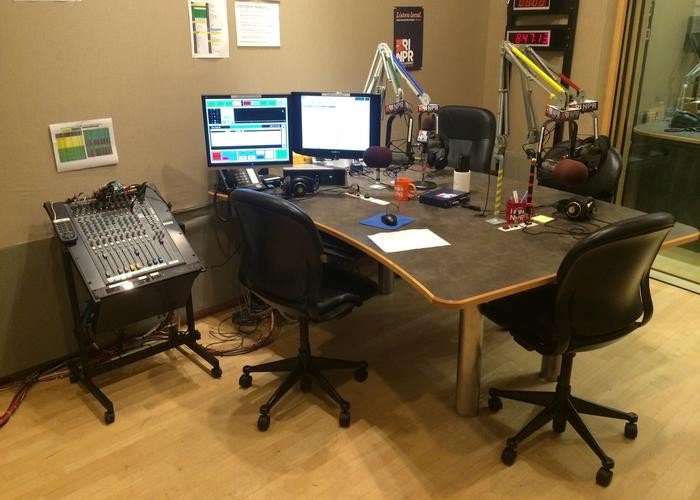
Late last week I was very happy to execute the final changeover to RIPR’s new PRODUCTION STUDIO. This is a big deal for us; our studios were originally designed and constructed by WBUR, way back in the late 1990’s when they owned RIPR (then just “WRNI”) outright, and most of the “back office” personnel were still located in Boston.

Accordingly, we only have one “studio”. It’s two connected rooms: a “control room” with the usual mix board, producer’s station, director’s station, etc…and a “mic booth” with just a trio of mics. The idea was that a lot of the day-to-day, off-air, production work was happening up in Boston, where WBUR had four main studios and seven edit booths. So the workload on RIPR’s end would be pretty light.
Fast-forward to 2007 and now we’re an independent news radio station with nine news staff and a ton of daily production needs. Yet only one studio to do it in! AAAAAHHHH!!! Scheduling conflicts were rampant.
A separate mixer and microphone were installed in the mic booth, but this was only a partial solution. It only had the one mic and no way to conduct interviews…either in-person or on the phone.
But now, with the Allen & Heath XB-14-2 mixer and some clever wiring, instead of a “control room” and “mic booth”, we have “Studio A” and “Studio B”. Each capable of sharing the same infrastructure together OR operating (almost) completely independent of each other.
Instead of our afternoon anchor or morning host having to be interrupted while a Political Roundtable records, or one of our reporters needs to interview a guest…now each studio can be used as needed without interrupting the other. Whether in-person (up to four RE20 mics), on the phone, or via ISDN (sort of a high-quality phone line), it’s all available in Studio B as well as Studio A. There’s a “DAW” (Digital Audio Workstation) running Adobe Audition (sound editing software) on Windows 7 that’s connected to the A&H mixer via USB. Plus three AudioVault AVAIR playback “carts” and the AVRPS record/play output – all networked to our other AudioVault workstations and servers around the office.
It was a tricky task given that there’s only one set of mics and headphones in the mic booth, and they have to be able to be used by either room on a moment’s notice. Fortunately we have Symetrix 528E mic processors that have multiple outputs.
I even got the “mic warning lights” (they come on when the mics are live, so people don’t open the studio door) wired up to work properly!
In addition this cleans out a lot of gear that’s now consolidated, and the mixer is on a portable rack that can be rolled out of the way if needed.
We’re still in the process of training all our reporters and staff on the new setup, but once everyone’s fully up to speed, this should make studio scheduling a lot easier for everyone and thus make RIPR that much more efficient at bringing you the news!

 L & R Broadcast Services
Leave a comment