
Credit: Aaron Read
The WELH the transmitter site is an 8x10ft shed with a single 12 inch desk fan blowing air out one of the wall vents, and no insulation whatsoever on the walls or ceiling. Temps routinely broke 120F inside, even when it was only 70 to 80F outside.
At this junction, credit must be given to Elenos, the manufacturer of our ETG3500 transmitter. Even in such harsh conditions, that little bugger just chugged right along. Faithfully pumping out 3000 watts (our effective radiated power is 4000 watts thanks to gain in the antennas) every day with nary a gripe.
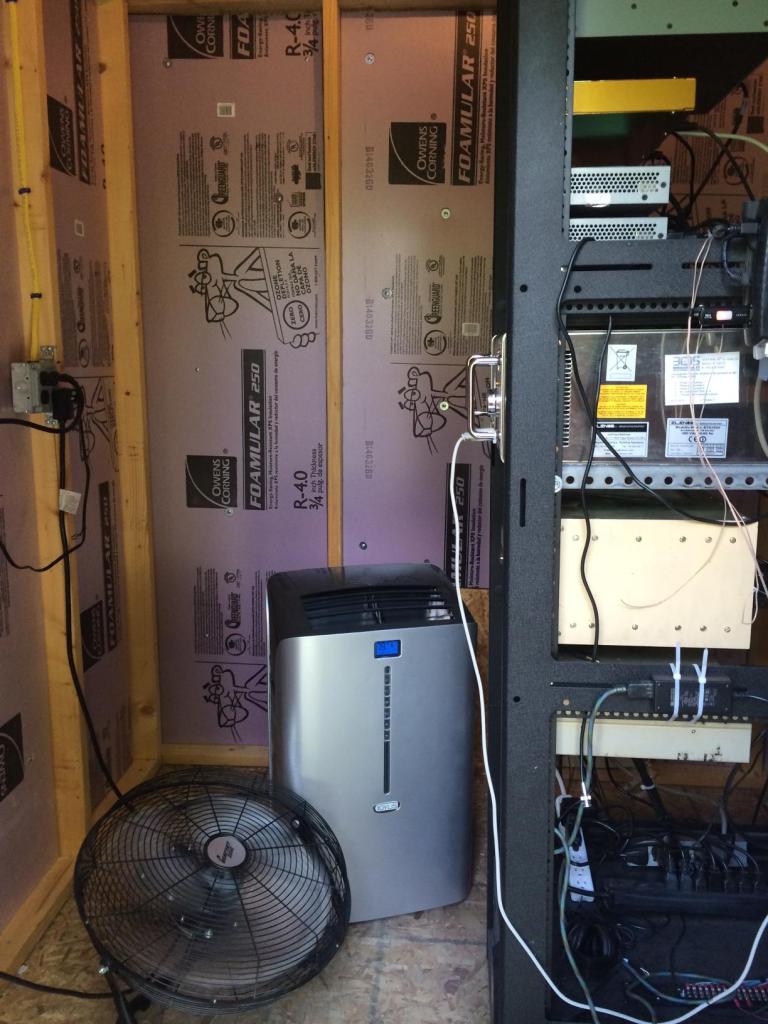
But now it’s got much less reason to gripe! We’ve lined the walls, ceiling, door and even the window with 3/4in insulated foam, and installed an Idylis 416710 portable air conditioner, with 12000 BTU of capacity. Plus a spare fan is in there to help keep air circulating. I also sealed up one of the wall vents and installed a simple 1in thick air filter across the other to help keep the incoming air from dirtying up the space.
Credit: Aaron Read
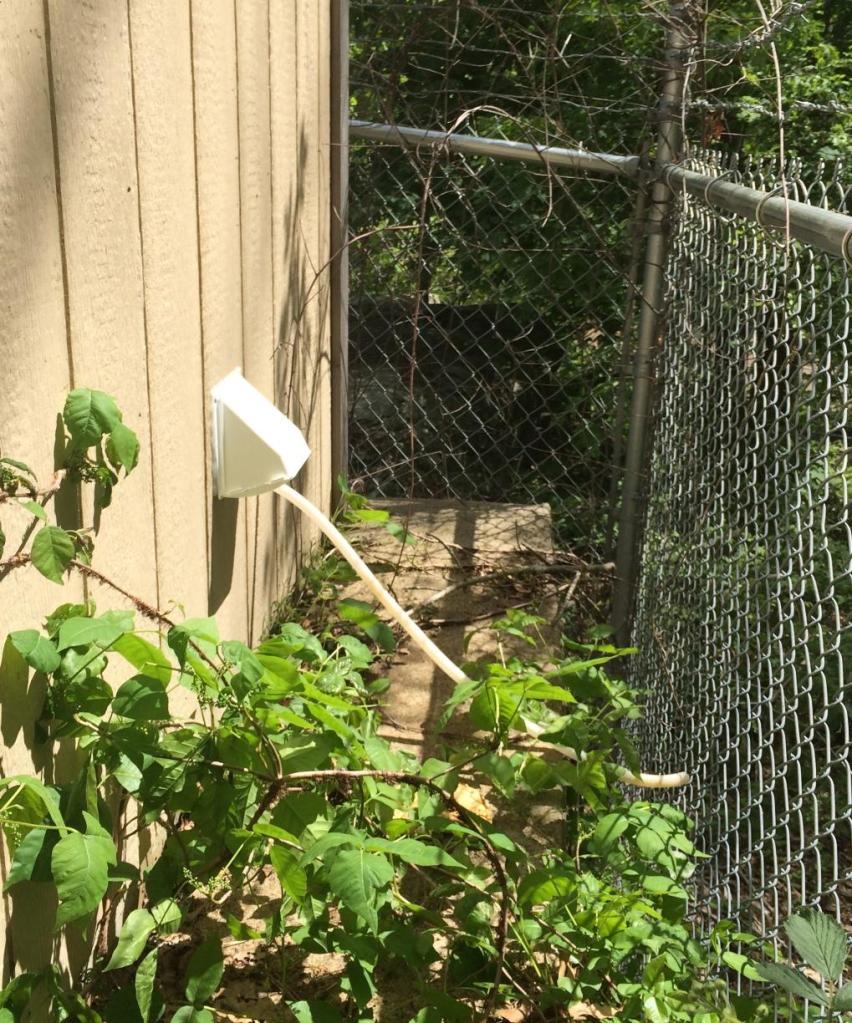
Remember: a portable A/C has to vent the hot air outside the structure. That air being blown from inside to outside must be replaced by air flowing outside to inside SOMEhow (nature abhors a vacuum). Best to channel it through a single entry point that you can control and filter. Obviously it’s impossible to hermetically seal the rest of the shed, but certainly that filter ought to help keep things a lot cleaner.
Believe it or not, we’re not entirely sure this’ll be enough! The insulation only has an R-value of 4, and that Elenos still puts out a lot of heat. What’s R-value? It’s how insulating the insulation is, and higher is better. A house with good attic insulation might an R-value of 40 to 50. But that’s thick, fluffy, fiberglass insulation. In our case, getting much more than 4 or 5 just isn’t possible. But certainly every little bit helps! Here’s why:
To calculate an R-value, take the difference between the outside temp (let’s say 80) and the desired inside temp (let’s say 70). Multiply that number by the square footage of the wall or ceiling space that’s being insulated (let’s say 6x10ft, or 60 sq.ft). Then divide by the R-value (here it’s 4). So you’ve got ((80-70=10)*60)/4 = 150BTU. So we need an air conditioner producing 150BTU’s of cooling continuously. Doesn’t seem like much, but that’s just one wall: multiply by four walls, plus the ceiling (it’s about the same size), and not every square inch of the walls and ceiling is perfectly insulated, and you have a major source of heat inside the room with the transmitter and other assorted electronics. That 12,000BTU capacity gets eaten up quickly!

Credit: Aaron Read
But we had this A/C available to us and it’s a good place to start. If it turns out we need more, we can always cut a larger hole in the wall to put in a “window unit” A/C which tend to be larger capacity and more effective (since they allow a true “closed loop” air handling system, instead of one that’s always drawing in outside air).
You might wonder WHY air conditioning is so important? It’s because of the electronics inside all the equipment. Some gear, like the Elenos transmitter, can be designed to last longer in extreme heat. But most stuff isn’t. The parts inside fail much faster in high heat: electrolytic capacitors literally dry out, cooling fan bearings wear out, integrated circuits overheat and melt (yes, melt). When you have proper cooling, you extend the MTBF substantially.
Now your intrepid engineer just needs a little cooling of his own, in the form of aloe! I was working outside much of the day to cut the foam and prepare it for installation. Very pleasant, but very sunny and I got a sunburn. Ouch!
Ed.note: several months later, I removed the window from the shed and installed a 10,000 BTU window-unit style air conditioner. Window units are inherently far more efficient as they are “closed loop”; a portable makes cold air by transferring the heat to air it vents to the outdoors. That vented air has to be replaced somehow, so warm/hot air from outside gets sucked in through various gaps and cracks in the building. The portable A/C was relegated to a “backup” in case the window-unit fails or “ices up” (a common problem running a window unit during the fall and winter).

 L & R Broadcast Services
Leave a comment